
 Fair Value Gap
 False Breakout Scanner
 Heiken Ashi Trend
 Stock Volatility Box
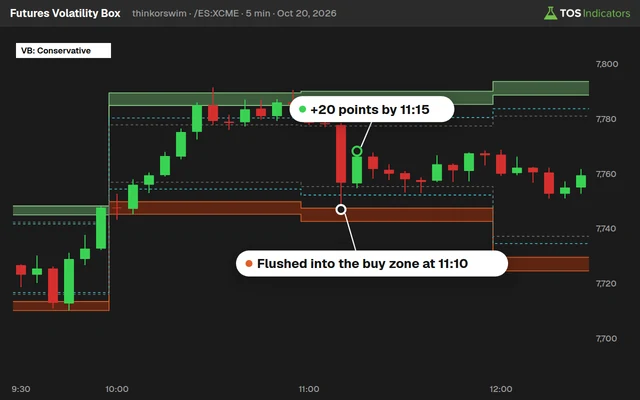 Futures Volatility Box
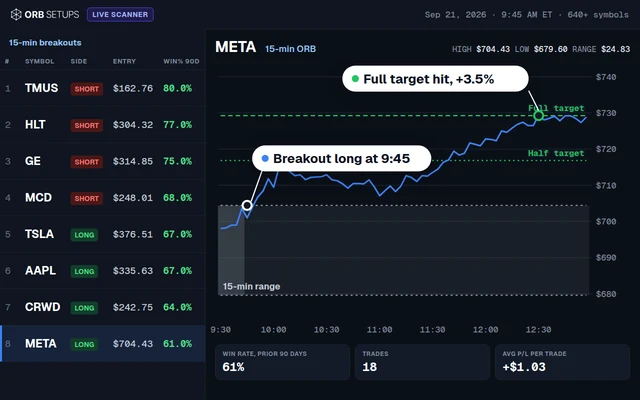 ORB Setups
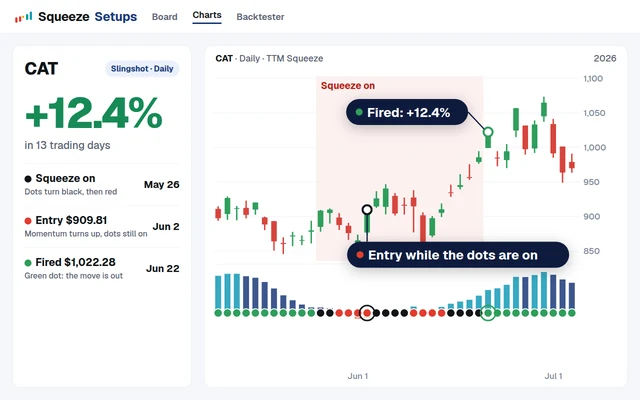 Squeeze Setups
The Experiment
In the companion video, we take the free moving average pullback backtester (available for download on our website) and run a systematic test on S&P 500 futures (ES) over two trend days: Thursday April 21st and Friday April 22nd. The goal is to answer four questions: which moving average gives the best pullback entries, do wider or smaller stops work better, is pullback-only or confirmation mode better, and which setup offers the best balance of P&L and effort?
The Test Framework
We tested three EMAs (8, 21, 34) in two entry modes each (pullback only vs. confirmation). Pullback only means entering blindly when price touches the EMA. Confirmation mode waits for price to close below the previous candle before entering. For each EMA/mode combination, we ran six different ATR multiplier sets for target and stop: 2/1, 2/2, 3/2, 4/2, 5/3, and 5/4. All tests ran on the 1-minute chart during regular market hours only.
A small code addition to the backtester restricted trades to regular market hours by checking seconds until 9:30 AM ET (market open) and 4:00 PM ET (market close). This prevented extended hours trades from muddying the results.
Results: 8 EMA
The 8 EMA pullback-only results across the six target/stop sets: 2/1 = $4,293.90, 2/2 = $6,483.58, 3/2 = lower, 4/2 = $5,118.88, 5/3 = $6,817.20, and 5/4 = $8,689.33. The pattern was clear: wider stops and wider targets produced higher P&L. The 5 ATR target with 4 ATR stop was the winner for the 8 EMA.
Confirmation mode on the 8 EMA produced lower numbers across the board: 2/1 was close to the pullback-only version, but 2/2 dropped to $3,669.36. The wider stop/target combinations (5/3 = $6,563.04, 5/4 = $7,748) were better but still below the pullback-only equivalents.
Results: 21 EMA and 34 EMA
The 21 EMA followed the same pattern. The highest P&L was 21 EMA, pullback only, 5 ATR target, 4 ATR stop = $8,891.61. This was the highest number across the entire test. The 34 EMA, same setup = $7,337.74, lower than both the 8 and 21 EMA versions. Waiting for a deeper pullback to the 34 EMA was not as effective as being more aggressive with the 8 or 21 on these trend days.
Answering the Four Questions
Which EMA was best? The 21 EMA at $8,891.61, followed closely by the 8 EMA at $8,689.33. The 34 EMA at $7,337.74 was the weakest.
Wider or smaller stops? Wider stops (4 ATR) were clearly better across the board. This makes sense on trend days where you want to give the trade room to work.
Pullback only or confirmation? Pullback only won, especially with the wider stop/target combinations. Confirmation mode was more selective but reduced P&L rather than improving it.
Best balance of P&L and effort? Run the same test on your preferred timeframe. Compare the number of trades it took to get to each P&L to measure efficiency. You could also expand with different ATR multipliers (6 ATR target, 7 ATR target) or contract to fit your risk profile.
Frequently Asked Questions
Which moving average performed best on trend days?
The 21 EMA with pullback-only entries, 5 ATR target, and 4 ATR stop produced the highest P&L at $8,891.61. The 8 EMA was close at $8,689.33. The 34 EMA trailed at $7,337.74.
Were wider stops or smaller stops better?
Wider stops (4 ATR) won across the board on trend days. The 5/4 (target/stop) combination was the best performer for every EMA tested.
Is pullback-only or confirmation mode better?
Pullback only was better, especially with wider stops and targets. Confirmation mode was more selective but produced lower P&L across every test scenario.
Can I run this on other markets?
Yes. The moving average pullback backtester is a free download. Import it into ThinkOrSwim, adjust the parameters (EMA length, ATR multipliers, regular hours filter), and run on any futures, stock, or ETF.
What timeframe was used?
1-minute chart on S&P 500 futures over two trend days (April 21-22). The same framework can be tested on 3-minute, 5-minute, or any other timeframe.
 How to Build a Moving Average Pullback Backtester in ThinkOrSwim
 An Easy Way to Recognize Trend Days
 Best ThinkOrSwim Indicators: 15 Custom Studies Every Trader Needs
 Trend Shift Scanner: Catch Reversals at the Inflection Point
 ES Futures Trading Strategy: Volatility Levels, ORB, and ATR-Based Entries