
How to Identify Intraday Reversals: A 5-Step Process
Learn a systematic 5-step process to identify intraday reversals using volatility levels, market internals, price action, and volume confirmation. Includes ThinkScript code and real examples.
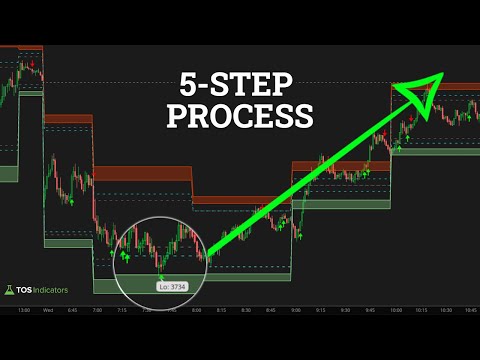
- Why Intraday Reversals Matter for Day Traders
- Step 1: Check If Price Is at a Significant Level
- Step 2: Look for Momentum Divergence
- Step 3: Watch for a Volume Spike (Capitulation)
- Step 4: Confirm with Market Internals
- Step 5: Wait for Price Structure Confirmation
- Common Reversal Patterns
- Choosing the Right Timeframe
- ThinkScript: Intraday Reversal Scanner
- Risk Management for Reversal Trades
- When NOT to Trade Reversals
- Putting It All Together: A Real-World Example
- Tools for Identifying Intraday Reversals
Why Intraday Reversals Matter for Day Traders
Intraday reversals are among the highest reward-to-risk setups available to day traders. When a stock or futures contract exhausts its move in one direction and snaps back, the resulting price action can deliver outsized gains in a compressed timeframe.
The challenge is obvious: most attempts to pick the bottom or fade the top end in losses. Traders who guess at reversals without a systematic framework get run over by trend continuation. You need a repeatable, multi-confirmation process rather than gut instinct.
This article walks through each step in detail, provides ThinkScript code you can use today, and shows you exactly when to avoid reversal trades altogether. Whether you trade equities or futures, the framework applies to any liquid intraday market.
Step 1: Check If Price Is at a Significant Level
Reversals do not happen at random prices. They occur at levels where large participants have resting orders—levels that carry historical or statistical significance. Your first job is to determine whether price has reached one of these zones.
Key Levels to Watch
VWAP acts as the institutional fair-value benchmark. Prior-day high and low represent obvious support and resistance where overnight orders cluster. The opening range high and low establish the first battle zone of the session.
Beyond these staples, Stock Volatility Box and Futures Volatility Box levels provide statistically derived boundaries based on expected daily range. When price reaches a volatility box extreme, the probability of mean reversion increases sharply.
| Level Type | Source | Strength | Best Used For |
|---|---|---|---|
| VWAP | Intraday calculation | High | Mean reversion to fair value |
| Prior Day High/Low | Daily chart | High | Support/resistance pivots |
| Opening Range | First 15-30 minutes | Moderate | Breakout failure reversals |
| Volatility Box Levels | Statistical model | Very High | Expected range extremes |
| Premarket High/Low | Premarket session | Moderate | Gap fill reversals |
If price is not at a significant level, skip the trade. This single filter eliminates the majority of false reversal signals and keeps you out of mid-range chop.
Step 2: Look for Momentum Divergence
Once price reaches a significant level, check whether momentum behind the move is weakening. Momentum divergence is your earliest warning that the current trend leg is running out of steam. It appears before price reverses, giving you a heads-up.
How Divergence Works
A bullish divergence forms when price makes a new low but the momentum indicator (RSI, MACD histogram, or $TICK) prints a higher low. This tells you that selling pressure is weakening even though price is still declining. The mirror image—bearish divergence—shows price making a new high while the indicator prints a lower high.
On the intraday timeframe, the NYSE TICK index ($TICK) is one of the most powerful divergence tools. If SPY makes a new low but $TICK prints higher lows, fewer stocks are actually ticking down. The broad selling pressure is dissipating.
Check RSI(14) on the 5-minute chart for classic divergence. Compare $TICK readings at each successive price low. Look at MACD histogram bars—are they getting shallower? If two out of three show divergence at a significant level, you have a strong foundation.
Step 3: Watch for a Volume Spike (Capitulation)
The third step is identifying a volume spike that signals capitulation. In a selloff, capitulation occurs when the last wave of panicked sellers dumps their positions at once. In a rally, the final wave of FOMO buying exhausts itself. Both events produce a distinct volume signature.
What Capitulation Looks Like
You will see a single candle or cluster of two to three candles with volume that is 2x to 4x the average of preceding bars. The price bar often has a long wick, showing that price traveled far but was rejected. This is the footprint of large orders absorbing panic flow.
Quantify this by comparing the bar's volume to a 20-period average. If the bar exceeds 200% of that average, it qualifies as a capitulation spike. The critical nuance: true capitulation volume produces a candle that closes well off its extreme, ideally in the upper half of its range for a bullish reversal.
Step 4: Confirm with Market Internals
Steps 1 through 3 focus on the individual chart. Step 4 zooms out to the broader market. Even a perfect reversal setup on a single instrument can fail if the overall market environment is hostile. Market internals give you the macro context.
Key Internals to Monitor
The NYSE TICK ($TICK) measures net stocks ticking up minus down. During a selloff, readings below -1000 indicate extreme selling. A reversal signal gains credibility when $TICK begins making higher lows even as the index makes new lows.
The Advance-Decline line ($ADD) tracks cumulative advancing versus declining issues. If $ADD starts turning up as price bounces, breadth confirms the move. If $ADD continues declining while price bounces, the rally is likely narrow and unsustainable.
| Internal | Symbol | Bullish Reversal Signal | Bearish Reversal Signal |
|---|---|---|---|
| NYSE TICK | $TICK | Higher lows above -800 | Lower highs below +800 |
| Advance-Decline | $ADD | Turning up from extreme low | Turning down from extreme high |
| Volume Up/Down | $VOLD | Ratio shifting to up volume | Ratio shifting to down volume |
Step 5: Wait for Price Structure Confirmation
The final step is the hardest psychologically. After steps 1 through 4 line up, you must wait for price to confirm the reversal. This means giving up some of the move in exchange for dramatically higher probability.
What Confirmation Looks Like
For a bullish reversal, confirmation is a higher low followed by a break above the most recent micro swing high. On the 5-minute chart, price makes a low, bounces, pulls back to form a higher low, and then breaks above the bounce high. This sequence proves buyers have taken control.
Another trigger is the break of a descending micro trendline drawn across the most recent lower highs. When price closes above that trendline on the 5-minute chart, the downtrend structure is broken.
Your entry comes on the break of the micro swing high (bullish) or swing low (bearish). The initial stop goes just beyond the reversal extreme. By the time you reach Step 5, you have filtered out the vast majority of false signals.
Common Reversal Patterns
Within the 5-step framework, the price pattern at the reversal point typically falls into one of three categories. Recognizing these patterns accelerates your decision-making.
V-Bottom (V-Top)
Price plunges sharply into a significant level on a volume spike, then immediately reverses with equal or greater momentum. There is no retest of the low. V-bottoms occur during news-driven selloffs or gap failures. Your entry is on the first pullback after the initial thrust, with a stop below the spike low.
Double Bottom (Double Top)
Price makes a low, bounces, returns to test the low with momentum divergence on the second test, and breaks above the bounce high. The two tests create clear support. The stop goes below the double bottom level. The target is a measured move equal to the pattern height projected above the breakout.
Morning Star / Evening Star
A three-candle pattern: a large bearish candle, a small indecision candle, and a large bullish candle closing above the midpoint of the first. On intraday charts this forms over 3 to 5 bars on the 5-minute timeframe. Entry is on the close of the third candle with the stop below the pattern low.
Choosing the Right Timeframe
The timeframe you use for reversal identification affects both signal speed and reliability. Each timeframe has distinct trade-offs.
The 1-minute chart offers the earliest signals but generates the most noise. Use it for spotting capitulation spikes and fine-tuning entries after the 5-minute confirms. The 5-minute chart is the workhorse for intraday reversals—it produces reliable divergence signals and clear patterns. The 15-minute chart identifies larger reversals that develop over 30 to 90 minutes with fewer but higher-conviction signals.
| Timeframe | Signal Speed | Noise Level | Best For | Trades Per Day |
|---|---|---|---|---|
| 1-Minute | Fastest | High | Entry timing, scalps | 5-10 |
| 5-Minute | Moderate | Low-Moderate | Primary reversal signals | 2-4 |
| 15-Minute | Slower | Low | High-conviction reversals | 1-2 |
ThinkScript: Intraday Reversal Scanner
This ThinkScript study combines multiple reversal signals into one indicator. It checks for price at extreme levels relative to VWAP, RSI divergence, and a volume spike—automating the first three steps so you can focus on internals and price confirmation.
# Intraday Reversal Signal Scanner
# Combines level, divergence, and volume for reversal detection

declare lower;

# --- Inputs ---
input rsiLength = 14;
input volMultiplier = 2.0;
input volAvgLength = 20;
input vwapDistancePercent = 0.5;
input lookbackBars = 10;

# --- VWAP Distance ---
def vwapLine = vwap;
def distFromVWAP = ((close - vwapLine) / vwapLine) * 100;
def atLowerExtreme = distFromVWAP <= -vwapDistancePercent;
def atUpperExtreme = distFromVWAP >= vwapDistancePercent;

# --- RSI Divergence ---
def rsiVal = RSI(length = rsiLength);
def priceLow = low;
def priceHigh = high;

def bullishDiv = priceLow < Lowest(priceLow, lookbackBars)[1]
    and rsiVal > Lowest(rsiVal, lookbackBars)[1];
def bearishDiv = priceHigh > Highest(priceHigh, lookbackBars)[1]
    and rsiVal < Highest(rsiVal, lookbackBars)[1];

# --- Volume Spike ---
def avgVol = Average(volume, volAvgLength);
def volSpike = volume >= avgVol * volMultiplier;

# --- Combined Signals ---
def bullReversal = atLowerExtreme and bullishDiv and volSpike;
def bearReversal = atUpperExtreme and bearishDiv and volSpike;

# --- Plots ---
plot BullSignal = if bullReversal then 1 else 0;
plot BearSignal = if bearReversal then -1 else 0;

BullSignal.SetPaintingStrategy(PaintingStrategy.HISTOGRAM);
BullSignal.SetDefaultColor(Color.GREEN);
BullSignal.SetLineWeight(3);

BearSignal.SetPaintingStrategy(PaintingStrategy.HISTOGRAM);
BearSignal.SetDefaultColor(Color.RED);
BearSignal.SetLineWeight(3);

# --- Alerts ---
Alert(bullReversal, "Bullish Reversal Signal", Alert.BAR, Sound.Ding);
Alert(bearReversal, "Bearish Reversal Signal", Alert.BAR, Sound.Ring);
This scanner plots green histogram bars when all three bullish conditions align and red bars for bearish setups. Apply it to a 5-minute chart of SPY, QQQ, or ES futures. When a signal fires, manually check Steps 4 and 5 before entering.
Adjust vwapDistancePercent to match your instrument. For ES futures, 0.3% to 0.5% from VWAP works well. For higher-volatility stocks, increase to 0.8% or more. Pair this with the Stacked Moving Averages indicator to distinguish trend-change reversals from pullback-reversals within the larger trend.
Risk Management for Reversal Trades
Reversal trades require tighter risk management than trend-following trades because you are entering against prevailing momentum. Discipline in stop placement and position sizing is non-negotiable.
Stop Placement Rules
Place your stop just beyond the reversal extreme—the lowest low for a bullish reversal or highest high for a bearish one. Add a buffer (2-3 ticks on futures, $0.05-0.10 on stocks) to account for stop runs.
| Instrument | Stop Buffer | Max Risk | R:R Target |
|---|---|---|---|
| ES Futures | 2-3 ticks | 2 points | 2:1 to 3:1 |
| NQ Futures | 3-4 ticks | 10 points | 2:1 to 3:1 |
| SPY/QQQ | $0.05-0.10 | 0.3% of price | 2:1 to 3:1 |
| Individual Stocks | $0.10-0.25 | 0.5% of price | 2:1 to 4:1 |
Profit Targets and Trailing
Minimum acceptable reward-to-risk is 2:1. Your first target should be the nearest significant level—VWAP, opening range midpoint, or prior-day close. Trail your stop to breakeven once price reaches 1:1, converting the trade to risk-free. A second target can extend to the opposite extreme of the day's range if the reversal develops into a trend change.
When NOT to Trade Reversals
Some market conditions are hostile to reversal trading. Recognizing them is just as important as knowing the 5-step process.
Trend Days
On a true trend day, price moves directionally from open to close with minimal pullbacks. Every apparent reversal is a trap. Internals stay persistently one-sided and volume supports the trend. Use the Recognize Trend Days framework to identify these early: a gap that does not fill in 30 minutes, $TICK persistently above +500 or below -500, and an opening range breakout that holds.
Breakaway Gaps
A breakaway gap occurs when a stock or index gaps significantly on high volume from a fundamental catalyst. These gaps establish a new range and do not fill intraday. If the gap exceeds the average daily range on volume above the 20-day average, do not attempt reversal trades back toward the gap fill.
Low Liquidity and News Events
Holiday sessions, pre-FOMC lulls, and midday doldrums (11:30 AM to 1:30 PM ET) produce unreliable signals. Limit reversal trading to the first 90 minutes and last 60 minutes. After major releases (CPI, FOMC, NFP), wait 15 to 20 minutes for the dust to settle before applying the framework.
Putting It All Together: A Real-World Example
Consider a bearish-to-bullish reversal on ES futures during the morning session. ES opens and sells off for 45 minutes, declining 15 points. At 10:15 AM, price reaches the lower volatility box level coinciding with the prior-day low. Step 1: significant level with confluence.
RSI(14) made its lowest reading at the first push down at 9:50 AM. The second push at 10:15 AM takes price lower, but RSI prints a higher low. $TICK also shows higher lows. Step 2: momentum divergence confirmed.
The 10:15 AM candle prints on 3.2x average volume with a long lower wick closing in the upper third. Step 3: capitulation volume. $TICK hit -1150 on the spike but recovered to -600; $ADD is flattening. Step 4: internals improving.
Over the next 15 minutes, ES forms a higher low and breaks above the bounce high. Step 5: price structure confirms. Entry on the breakout with a stop 1 point below the spike low.
Tools for Identifying Intraday Reversals
The following tools help you implement each step of the reversal framework described in this article.

Ready to Trade With an Edge?
Join 40,000+ traders using institutional-grade tools for ThinkOrSwim.
Get the Bundle