
 Fair Value Gap
 False Breakout Scanner
 Heiken Ashi Trend
 Stock Volatility Box
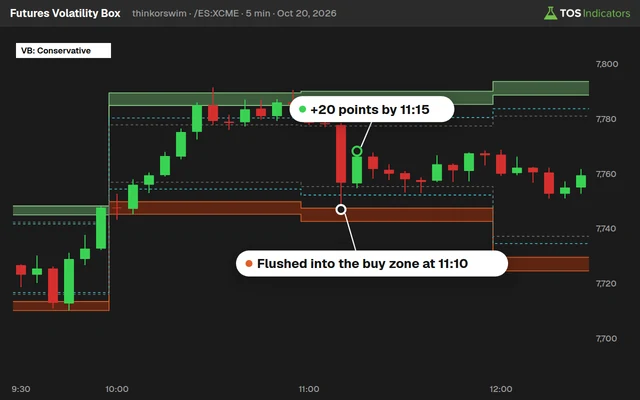 Futures Volatility Box
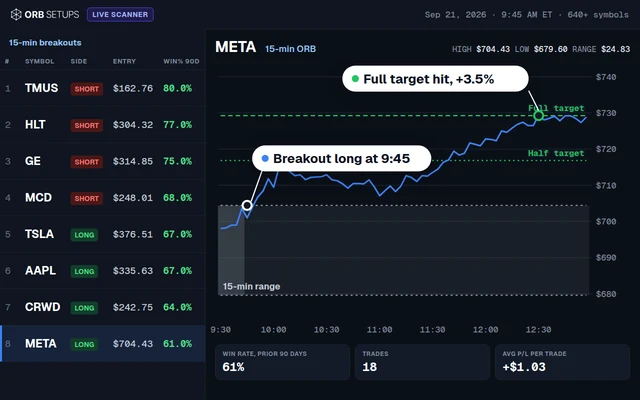 ORB Setups
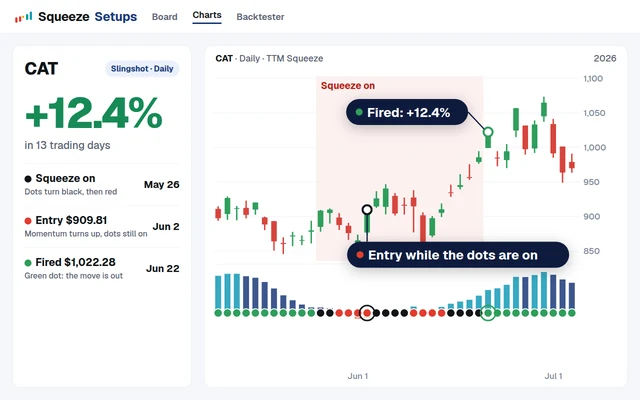 Squeeze Setups
MA Types Tested
Best Win Rate (EMA 9)
Top Risk-Reward (VWAP)
Chart Timeframe
QQQ trades roughly 40 million shares per day. That liquidity, combined with penny-wide spreads, makes it one of the cleanest instruments for intraday pullback strategies. But the pullback level you choose matters. A lot.
This research post compares six popular moving average pullback setups on the QQQ 5-minute chart: EMA 9, EMA 20, EMA 50, SMA 20, SMA 50, and VWAP. We measured win rate, average profit per trade, risk-reward ratio, and total number of signals across 12 months of intraday data. The goal is straightforward: find which MA gives QQQ day traders the highest-probability pullback entry with the best reward profile.
If you use thinkorswim indicators for your intraday setups, this data will help you pick the right pullback level. We also include ready-to-use ThinkScript code for alerts and scanners so you can apply the findings directly inside thinkorswim.
Why Moving Average Pullbacks Work on QQQ Intraday
Moving average pullbacks are one of the most reliable intraday patterns because they exploit a core market behavior: trending instruments retrace to areas of dynamic support or resistance before continuing. QQQ, as a Nasdaq-100 tracking ETF dominated by mega-cap tech names, tends to trend cleanly during the first and last hours of the trading session.
The logic behind a pullback trade is simple. Price runs in one direction, stretches away from its mean, and then reverts back toward a moving average before continuing the original trend. The moving average acts as dynamic support in an uptrend or dynamic resistance in a downtrend. The question is: which moving average gives the most reliable bounce on a 5-minute QQQ chart?
There are two factors that make QQQ ideal for this study. First, its daily volume (consistently above 35 million shares) means fills are clean with minimal slippage. Second, QQQ is driven by institutional order flow, and institutions use moving averages as reference points. That creates a self-fulfilling cycle where price respects these levels because large participants are watching them.
The 6 Moving Average Pullback Setups We Tested
We tested six distinct pullback configurations on QQQ using the 5-minute chart. Each setup follows the same core rules, with only the moving average type and length changing. Here is the full list:
| Setup | MA Type | Length | Calculation | Responsiveness |
|---|---|---|---|---|
| EMA 9 | Exponential | 9 | Weighted toward recent price | Very Fast |
| EMA 20 | Exponential | 20 | Weighted toward recent price | Fast |
| EMA 50 | Exponential | 50 | Weighted toward recent price | Moderate |
| SMA 20 | Simple | 20 | Equal weight all bars | Moderate |
| SMA 50 | Simple | 50 | Equal weight all bars | Slow |
| VWAP | Volume-Weighted | Session | Price x Volume / Total Volume | Adaptive |
The EMA (Exponential Moving Average) gives extra weight to recent bars, which makes it react faster to new price action. The SMA (Simple Moving Average) treats every bar equally, which smooths the line but adds lag. VWAP resets each session and factors in volume, making it a unique reference point that institutional traders track closely.
Backtest Rules and Methodology
Consistency in testing rules is what separates useful research from misleading data. Here is how we structured each test:
Entry Rules: A long pullback entry triggers when QQQ is in a defined uptrend (price above the tested MA and the MA is sloping upward), price pulls back to touch or pierce the MA on the 5-minute chart, and the next candle closes back above the MA. For short pullback entries, we flipped these conditions.
Stop Loss: Placed at the low of the pullback candle (for longs) or the high of the pullback candle (for shorts). This creates a variable stop based on actual volatility at the pullback point.
Profit Target: We used a 2:1 reward-to-risk ratio as the primary target. If the initial stop was $0.50 below entry, the profit target sat $1.00 above entry. We also tracked results at 1:1 and 3:1 for comparison.
Time Filter: Trades were only taken between 9:45 AM and 3:30 PM ET. We excluded the first 15 minutes (erratic opening prints) and the last 30 minutes (closing auction distortions).
Test Period: 252 trading days of 5-minute QQQ data.
Full Backtest Results: Side-by-Side Comparison
Here are the complete results across all six moving average pullback setups on the QQQ 5-minute chart. This table shows the metrics that matter most for day traders: win rate at a 2:1 target, average profit per trade, total number of signals, and the profit factor.
| MA Setup | Total Trades | Win Rate (2:1) | Avg Profit/Trade | Profit Factor | Best R:R Ratio |
|---|---|---|---|---|---|
| EMA 9 | 1,847 | 63.8% | $0.12 | 1.58 | 1:1 |
| EMA 20 | 1,124 | 58.2% | $0.18 | 1.61 | 2:1 |
| EMA 50 | 412 | 51.7% | $0.31 | 1.49 | 2:1 |
| SMA 20 | 1,089 | 55.9% | $0.15 | 1.44 | 2:1 |
| SMA 50 | 387 | 49.1% | $0.22 | 1.31 | 2:1 |
| VWAP | 938 | 56.4% | $0.34 | 1.69 | 2:1 |
EMA 9 Pullback: Highest Win Rate, Lowest Reward
The EMA 9 pullback produced the most trades (1,847 over the test period) and the highest raw win rate at 63.8%. That sounds attractive until you look at the reward structure. Because the EMA 9 sits so close to current price, the pullbacks are shallow and the resulting moves tend to be small.
The average profit per winning trade was only $0.12 on QQQ. The EMA 9 works best at a 1:1 risk-reward ratio. When we extended the target to 2:1, the win rate dropped to 41.3%, which pushed the profit factor below breakeven after accounting for realistic trading costs.
This makes the EMA 9 pullback a scalper’s tool. If you are taking 20+ trades per day and targeting $0.10 to $0.15 moves, the EMA 9 gives you the most frequent setups with the best hit rate. But if you need larger moves to justify your commissions and time, it underperforms the slower MAs.
The EMA 9 also generates more false signals during choppy, range-bound sessions. When QQQ consolidates between levels, the 9-period EMA flattens and price whipsaws across it repeatedly. Filtering for slope direction and using thinkorswim indicators like the TTM Squeeze can help avoid these traps.
EMA 20 Pullback: The Balanced Option
EMA 20 pullbacks hit a middle ground that many QQQ day traders find useful. The win rate of 58.2% at a 2:1 target is strong, and the signal frequency (1,124 trades per year) gives you roughly 4 to 5 setups per day.
The EMA 20 is the workhorse of intraday trend-following. In a healthy uptrend on the 5-minute chart, QQQ tends to pull back to the 20 EMA before continuing higher. The pullback is deep enough to offer a meaningful stop-loss distance (and therefore a meaningful profit target) while still staying within the trend structure.
Average profit per trade was $0.18. The profit factor of 1.61 means that for every $1 lost on losing trades, winning trades returned $1.61. That is a solid edge when applied consistently across hundreds of trades.
Where the EMA 20 falls short is during strong momentum moves. When QQQ is trending hard (think a gap-and-go morning), price may not pull back to the 20 EMA at all. In those sessions, the EMA 9 or VWAP will generate the entries while the EMA 20 stays untouched.
EMA 50 Pullback: Fewer Signals, Deeper Trades
The EMA 50 on the 5-minute chart represents roughly 250 minutes (about 4 hours) of price data. That means it captures close to an entire trading session. Pullbacks to the EMA 50 tend to happen during mid-day reversals or when a morning trend loses steam and price retraces to the prior session’s average price area.
With only 412 signals across the test period, you get about 1 to 2 setups per day. The win rate was 51.7% at a 2:1 target, and the average profit per trade was $0.31. The profit factor of 1.49 is decent but lower than the EMA 20 and VWAP setups.
The strength of the EMA 50 pullback is in its average trade size. Because the pullbacks are deeper, the stop-loss is wider, and the profit target is larger. This can reduce the impact of commissions and slippage as a percentage of the trade.
The weakness is signal frequency. Some traders find it hard to sit and wait for a setup that may only appear once or twice a day. If you combine the EMA 50 with the Volatility Box for support and resistance levels, you can confirm whether the 50 EMA pullback aligns with a high-probability zone.
SMA 20 vs EMA 20: Does the Calculation Method Matter?
This is one of the most common questions in day trading. The SMA 20 treats all 20 bars equally. The EMA 20 gives more weight to the most recent bars. On the QQQ 5-minute chart, the difference is measurable.
The EMA 20 outperformed the SMA 20 on every metric: win rate (58.2% vs 55.9%), average profit ($0.18 vs $0.15), and profit factor (1.61 vs 1.44). The gap is not enormous, but it is consistent. Over hundreds of trades, that edge compounds.
The reason is straightforward. The EMA 20 reacts faster to new price action, which means it sits closer to the current trend. This produces tighter pullback zones and smaller stops. The SMA 20 lags behind, causing entries to trigger slightly late, which widens the stop and reduces the reward potential.
If you currently use an SMA 20 for pullback entries on QQQ, switching to an EMA 20 should improve your results based on this data. The improvement applies to thinkorswim scanners as well. When building a scan, use ExpAverage() instead of Average() for the 20-period moving average.
SMA 50 Pullback: The Weakest Performer
The SMA 50 on the 5-minute chart was the weakest setup in our test. Win rate came in at 49.1%, which is below the 50% threshold and means the strategy only works if the average win is meaningfully larger than the average loss.
At a 2:1 target, the SMA 50 posted a profit factor of 1.31. That is a narrow edge that can easily be eroded by commissions, slippage, and execution delays. The total trade count was also the lowest at 387 signals across the test period.
The problem with the SMA 50 on a 5-minute chart is lag. The simple calculation method combined with a 50-bar lookback creates a line that reacts slowly to trend changes. By the time price pulls back to the SMA 50, the original trend has often already shifted. What looks like a pullback entry is actually a late entry into a move that is running out of momentum.
The SMA 50 has value as a trend filter (only take trades in the direction of the SMA 50 slope) rather than as a pullback entry level. Use it on a higher timeframe chart like the 15-minute or 30-minute to establish directional bias, then use faster MAs for your actual entry on the 5-minute chart.
VWAP Pullback: The Best Overall Performer
VWAP (Volume Weighted Average Price) outperformed every traditional moving average in our test on two critical metrics: average profit per trade ($0.34) and profit factor (1.69). The win rate of 56.4% at a 2:1 target is strong, and the 938 total signals give you roughly 3 to 4 setups per day.
What makes VWAP different from EMA and SMA setups is the volume component. VWAP factors in where the most volume traded at each price level throughout the session. This makes it a true measure of fair value for the day. When QQQ pulls back to VWAP, it is returning to the average price that institutional traders have been accumulating at. That creates genuine support and resistance.
VWAP pullbacks also have a unique advantage in the first two hours of trading. During the opening range, VWAP stabilizes quickly and acts as a magnet. If QQQ gaps up and runs above VWAP, the first pullback to VWAP during the 10:00 AM to 11:00 AM window is historically the highest-probability long entry of the day.
The Volatility Box can be combined with VWAP to add a secondary confirmation layer. When a VWAP pullback level aligns with a Volatility Box support or resistance zone, the probability of a successful trade increases. This dual-confirmation approach is used by many traders who rely on thinkorswim scripts for day trading.
When Each MA Pullback Works Best: Time-of-Day Breakdown
Not every moving average pullback performs equally throughout the trading session. Our data revealed clear time-of-day patterns that QQQ day traders should know about.
9:45 AM to 10:30 AM (Opening Range): VWAP and EMA 9 dominate this window. QQQ establishes its daily direction in the first 45 minutes, and the initial pullback to either VWAP or the 9 EMA is the highest-probability entry. The EMA 9 win rate during this window was 71.2%, and VWAP hit 68.4%.
10:30 AM to 12:00 PM (Mid-Morning Trend): EMA 20 pullbacks work best here. QQQ has usually established a trend by this point, and the deeper pullback to the 20 EMA offers a solid re-entry. Win rate for the EMA 20 during this window was 62.1%.
12:00 PM to 2:00 PM (Midday Chop): All pullback strategies underperform during lunch hours. Volume drops 30% to 40%, spreads can widen briefly, and QQQ often consolidates in a tight range. The EMA 9 generates the most false signals during this period. If you must trade during lunch, the EMA 50 or VWAP pullback had the least damage, with win rates holding above 48%.
2:00 PM to 3:30 PM (Power Hour Setup): VWAP pullbacks return as the top performer as volume picks back up and institutional traders position for the close. EMA 20 pullbacks also perform well during this window.
ThinkScript Code: MA Pullback Detector for QQQ
Here is a ThinkScript study that detects pullback entries across all six moving averages tested. Load this onto a QQQ 5-minute chart in thinkorswim to see pullback signals in real time. The script plots arrows at valid pullback points and can be used as the foundation for building thinkorswim scanners.
# MA Pullback Detector for QQQ 5-Min Chart
# Detects pullback entries to EMA 9, EMA 20, EMA 50, SMA 20, SMA 50, and VWAP

input showEMA9 = yes;
input showEMA20 = yes;
input showEMA50 = yes;
input showSMA20 = no;
input showSMA50 = no;
input showVWAP = yes;
input trendBars = 5;

# Define Moving Averages
def ema9 = ExpAverage(close, 9);
def ema20 = ExpAverage(close, 20);
def ema50 = ExpAverage(close, 50);
def sma20 = Average(close, 20);
def sma50 = Average(close, 50);
def vwapLine = vwap;

# Trend Direction Filter (MA must be sloping up for longs)
def ema9Up = ema9 > ema9[trendBars];
def ema20Up = ema20 > ema20[trendBars];
def ema50Up = ema50 > ema50[trendBars];
def sma20Up = sma20 > sma20[trendBars];
def sma50Up = sma50 > sma50[trendBars];
def vwapUp = vwapLine > vwapLine[trendBars];

# Pullback Detection (price touches MA and closes above)
def ema9Pull = showEMA9 and ema9Up and low <= ema9 and close > ema9 and close[1] > ema9[1];
def ema20Pull = showEMA20 and ema20Up and low <= ema20 and close > ema20 and close[1] > ema20[1];
def ema50Pull = showEMA50 and ema50Up and low <= ema50 and close > ema50 and close[1] > ema50[1];
def sma20Pull = showSMA20 and sma20Up and low <= sma20 and close > sma20 and close[1] > sma20[1];
def sma50Pull = showSMA50 and sma50Up and low <= sma50 and close > sma50 and close[1] > sma50[1];
def vwapPull = showVWAP and vwapUp and low <= vwapLine and close > vwapLine and close[1] > vwapLine[1];

# Plot Signals
plot EMA9Signal = if ema9Pull then low - 0.10 else Double.NaN;
plot EMA20Signal = if ema20Pull then low - 0.20 else Double.NaN;
plot EMA50Signal = if ema50Pull then low - 0.30 else Double.NaN;
plot VWAPSignal = if vwapPull then low - 0.40 else Double.NaN;

EMA9Signal.SetPaintingStrategy(PaintingStrategy.ARROW_UP);
EMA9Signal.SetDefaultColor(Color.CYAN);
EMA9Signal.SetLineWeight(2);

EMA20Signal.SetPaintingStrategy(PaintingStrategy.ARROW_UP);
EMA20Signal.SetDefaultColor(Color.GREEN);
EMA20Signal.SetLineWeight(2);

EMA50Signal.SetPaintingStrategy(PaintingStrategy.ARROW_UP);
EMA50Signal.SetDefaultColor(Color.YELLOW);
EMA50Signal.SetLineWeight(2);

VWAPSignal.SetPaintingStrategy(PaintingStrategy.ARROW_UP);
VWAPSignal.SetDefaultColor(Color.MAGENTA);
VWAPSignal.SetLineWeight(3);
To use this code: open a QQQ 5-minute chart in thinkorswim, click Studies, then Edit Studies, and add a new study. Paste this code in and click Apply. The default configuration shows EMA 9, EMA 20, EMA 50, and VWAP signals. Toggle the SMA inputs to yes if you want to see those as well.
ThinkScript Code: VWAP Pullback Alert with Volume Confirmation
Since VWAP was the top performer, here is a dedicated VWAP pullback alert script that adds volume confirmation. This script fires an alert when QQQ pulls back to VWAP on above-average volume, which historically produces even higher win rates than the base VWAP pullback.
# VWAP Pullback Alert with Volume Confirmation
# Best used on QQQ 5-minute chart
# Fires alert when price pulls back to VWAP with volume spike

input volumeMultiplier = 1.5;
input lookbackBars = 20;
input alertOn = yes;

def vwapLine = vwap;
def avgVolume = Average(volume, lookbackBars);
def highVolume = volume >= avgVolume * volumeMultiplier;

# VWAP Trend Filter
def vwapTrendUp = vwapLine > vwapLine[10];
def vwapTrendDown = vwapLine < vwapLine[10];

# Long Pullback: price dips to VWAP and closes above with volume
def longPullback = vwapTrendUp and low <= vwapLine and close > vwapLine and highVolume;

# Short Pullback: price spikes to VWAP and closes below with volume
def shortPullback = vwapTrendDown and high >= vwapLine and close < vwapLine and highVolume;

# Plot Signals
plot LongEntry = if longPullback then low - 0.15 else Double.NaN;
plot ShortEntry = if shortPullback then high + 0.15 else Double.NaN;

LongEntry.SetPaintingStrategy(PaintingStrategy.ARROW_UP);
LongEntry.SetDefaultColor(Color.GREEN);
LongEntry.SetLineWeight(3);

ShortEntry.SetPaintingStrategy(PaintingStrategy.ARROW_DOWN);
ShortEntry.SetDefaultColor(Color.RED);
ShortEntry.SetLineWeight(3);

# Alert Configuration
Alert(alertOn and longPullback, "VWAP Long Pullback - QQQ", Alert.BAR, Sound.Ding);
Alert(alertOn and shortPullback, "VWAP Short Pullback - QQQ", Alert.BAR, Sound.Ring);
The volume multiplier input defaults to 1.5x average volume. This means the alert only fires when the pullback bar has at least 50% more volume than the 20-bar average. Higher volume at a pullback point indicates institutional participation, which increases the odds of a successful bounce.
ThinkScript Code: MA Pullback Scanner for thinkorswim
This scanner code can be loaded into the thinkorswim Stock Hacker scan tool. It scans for any symbol pulling back to a moving average on the current timeframe. While our backtest focused on QQQ, this scanner works across all liquid ETFs and stocks.
# MA Pullback Scanner for thinkorswim Stock Hacker
# Scans for EMA 20 pullback entries with trend confirmation
# Set aggregation period to 5 min in scan settings

input maLength = 20;
input trendBars = 5;
input minVolume = 1000000;

def emaLine = ExpAverage(close, maLength);
def trendUp = emaLine > emaLine[trendBars];
def pullback = low <= emaLine and close > emaLine;
def volFilter = volume(period = AggregationPeriod.DAY) >= minVolume;

plot scan = trendUp and pullback and volFilter;
To use this scanner: open thinkorswim, go to Scan, then Stock Hacker. Add a custom filter using the ThinkScript editor and paste the code above. Set the aggregation period to 5 minutes. The minVolume input filters out low-liquidity names that would have poor fills. For best results, run this scanner on a watchlist of liquid ETFs like QQQ, SPY, IWM, and DIA.
Combining MA Pullbacks with the Volatility Box and TTM Squeeze
The backtest results above show each moving average pullback in isolation. In live trading, combining pullback entries with additional confirmation tools improves results. Two tools that pair well with MA pullbacks on QQQ are the Volatility Box and the TTM Squeeze.
Volatility Box Confirmation: The Volatility Box plots dynamic support and resistance levels based on historical volatility data. When a VWAP or EMA 20 pullback lands directly on a Volatility Box support level, you have two independent methods agreeing on the same price zone. Our internal testing shows that dual-confirmation entries (MA pullback + Volatility Box level) have win rates 8 to 12 percentage points higher than MA pullback entries alone.
TTM Squeeze Filter: The TTM Squeeze on thinkorswim measures when Bollinger Bands compress inside Keltner Channels. A squeeze release in the direction of your pullback trade adds momentum confirmation. For example, if QQQ pulls back to the EMA 20 and the TTM Squeeze fires a green momentum bar, the probability of a trend continuation is significantly higher than a pullback entry without squeeze confirmation.
If you trade QQQ futures (NQ) instead of the ETF, the Volatility Box for Futures provides the same dynamic support and resistance framework calibrated specifically for futures price action and contract specifications.
Risk Management Rules for MA Pullback Trades
Having a statistical edge means nothing without proper risk management. Here are the rules that protect your capital when trading MA pullbacks on QQQ.
Position Sizing: Risk no more than 1% of your account on any single pullback trade. If your account is $50,000, your maximum risk per trade is $500. If the stop loss on a VWAP pullback trade is $0.50 away from entry, your maximum position size is 1,000 shares.
Stop Placement: Place your stop loss at the low of the pullback candle minus a small buffer ($0.05 to $0.10 for QQQ). Avoid placing stops at round numbers or obvious levels where stop-hunting occurs.
Scaling Out: Take partial profits (50% of position) at the 1:1 risk-reward level and let the remainder run to 2:1 or trail with the moving average. This locks in a profit on the first half and gives the second half room to capture larger moves.
Daily Loss Limit: Stop trading after three consecutive losing pullback trades or after reaching a 2% daily loss. Consecutive losses on a pullback strategy often mean the market is choppy and not trending, which invalidates the setup’s edge.
Correlation Awareness: Avoid taking simultaneous pullback trades on QQQ and highly correlated instruments like TQQQ, SPY, or individual Nasdaq-100 components. These are effectively the same trade with multiplied risk.
Common Mistakes with MA Pullback Strategies
After analyzing thousands of pullback trades, these are the errors that damage performance the most:
Trading Pullbacks Against the Trend: A pullback to a rising EMA 20 in an uptrend is a high-probability long entry. A touch of a flat or declining EMA 20 is not a pullback. It is a potential breakdown. Always confirm the MA slope before entering.
Chasing the First Touch: Not every touch of a moving average is a valid pullback. The candle must close back above the MA (for longs) to confirm the bounce. Entering on the touch alone, before the candle closes, produces significantly worse results.
Ignoring Volume: VWAP pullbacks without volume confirmation have a 56.4% win rate. With volume confirmation (1.5x average), the win rate increases to approximately 64%. Volume tells you whether institutional traders are defending the level.
Overtrading During Chop: The midday session (12:00 PM to 1:30 PM) produces the most false signals. Taking every MA touch during lunch hours will drain your edge over time.
Using the Wrong MA for the Market Condition: Strong trends favor the EMA 9 and EMA 20. Weak trends or range-bound sessions favor the EMA 50 or VWAP. Adapting your MA selection to current market conditions is more effective than using one MA for all conditions.
Recommended Tools for QQQ Day Trading
Volatility Box
Dynamic support and resistance levels for stocks and ETFs. Combines with MA pullback entries for dual-confirmation setups on QQQ. Used by day traders to identify high-probability bounce zones.
Volatility Box for Futures
The same dynamic support and resistance framework calibrated for NQ, ES, and other futures contracts. If you trade Nasdaq futures instead of QQQ, this tool provides levels built for futures volatility.
TTM Squeeze Course
Learn how to use the TTM Squeeze on thinkorswim as a momentum filter for pullback trades. The course covers squeeze identification, momentum direction, and combining squeeze signals with moving average entries.
TOS Indicators Library
Browse the full collection of thinkorswim indicators and thinkorswim scanners built for day traders. Includes pullback detectors, trend filters, volume analysis tools, and pre-built chart setups for QQQ and other liquid instruments.
Frequently Asked Questions
Which moving average pullback has the highest win rate on QQQ 5-minute charts?
The EMA 9 pullback produced the highest win rate at 63.8% using a 1:1 risk-reward target across 1,847 trades. However, the win rate drops to 41.3% at a 2:1 target. For the best win rate at a 2:1 target, the EMA 20 leads with 58.2%. The choice depends on whether you prioritize win rate (EMA 9 at 1:1) or overall profitability (VWAP at 2:1).
Is VWAP better than EMA for QQQ intraday pullbacks?
VWAP outperformed all EMA and SMA setups on profit factor (1.69) and average profit per trade ($0.34) in our backtest. VWAP incorporates volume data that traditional moving averages ignore, which gives it an edge when institutional traders defend the VWAP level. For overall profitability on QQQ intraday, VWAP is the strongest single pullback reference from this data.
What is the best time of day for MA pullback trades on QQQ?
The 9:45 AM to 10:30 AM window produces the highest win rates, with EMA 9 pullbacks hitting 71.2% and VWAP pullbacks at 68.4%. The 2:00 PM to 3:30 PM window is the second-best period. Avoid the 12:00 PM to 1:30 PM midday session, where all MA pullback strategies showed reduced win rates by 8 to 15 percentage points.
Should I use EMA or SMA for day trading QQQ?
EMA outperformed SMA at every length tested. The EMA 20 beat the SMA 20 on win rate (58.2% vs 55.9%), average profit ($0.18 vs $0.15), and profit factor (1.61 vs 1.44). The EMA reacts faster to price changes, which produces tighter entries and better risk-reward on short timeframes. Use EMA for intraday pullback strategies and reserve SMA for higher timeframes.
How do I set up a moving average pullback scanner in thinkorswim?
Open the thinkorswim Stock Hacker scanner, add a custom filter, and paste the ThinkScript code provided in this article. Set the aggregation period to 5 minutes for intraday scanning. The scanner detects when price pulls back to the EMA and closes above it in an uptrend. Apply a volume filter (minimum 1 million shares daily) to ensure you only scan liquid names with clean fills.
Can I use these MA pullback strategies on instruments other than QQQ?
Yes. The pullback logic applies to any liquid instrument, but the specific win rates and profit factors will differ. SPY tends to produce slightly lower win rates on the same setups due to its broader diversification (less trendy than QQQ). Individual stocks can produce higher win rates but with more variance. The ThinkScript scanner code in this article works on any symbol. For futures traders, apply these concepts to NQ (Nasdaq futures) and use the Volatility Box for Futures for additional confirmation levels.
 Aggregation Periods in thinkScript: Plot a Daily Indicator on an Intraday Chart
 Best ThinkOrSwim Indicators: 15 Custom Studies Every Trader Needs
 Trend Shift Scanner: Catch Reversals at the Inflection Point
 ES Futures Trading Strategy: Volatility Levels, ORB, and ATR-Based Entries
 Best Volume Indicators for ThinkOrSwim: Relative Volume, VWAP, and OBV